


Lhasa's Nanshan Park ready for soil and water conservation designation
Updated: 2026-07-27 By Guo Yanqi and Zhu Lixin in Lhasa (chinadaily.com.cn)  Print
Print 


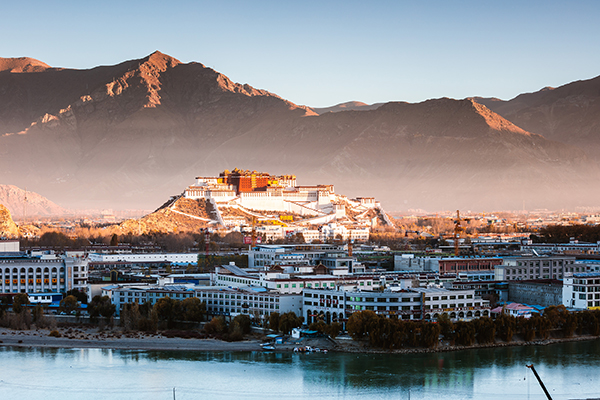
A view of the Potala Palace from Nanshan Park in Lhasa, Xizang autonomous region. [Photo by Zhu Lixin/chinadaily.com.cn]
The transformation was far from easy. At elevations ranging from 3,700 to 4,100 meters, workers initially relied on manual labor and pack animals to carry saplings up steep slopes. Irrigation pipes frequently froze during winter, making it difficult to keep newly planted trees alive, according to Xinhua News Agency. Drones were later introduced to transport saplings, while sprinkler irrigation and environmental monitoring systems were installed to support maintenance.
"The challenge was more than just getting the trees up the mountain, but maintaining them after they had been planted," Shilog Tsedan told a delegation of Chinese and international journalists.
Covering about 2.3 square kilometers, the park includes roughly 107 hectares of planted land. According to its operator, it is home to more than 1 million trees representing over 80 species, with a survival rate exceeding 90 percent.